Facebook Pixel Skip to main content

📣SCRIPT SALE! Treat yourself to an easier Fall. Save 30% on 5+ perusal scripts with code SPRING30 before May 3 and head into summer stress-free.

Greek

Theatrefolk Featured Play - Agatha Rex
Featured Plays

Theatrefolk Featured Play - Agatha Rex

Welcome to our Featured Play Spotlight. Agatha Rex by Lindsay Price is a modern high school adaptation of Antigone, transforming the Greek chorus into a dynamic ensemble opportunity. Available in a competition-length version too! Possible expulsion, expulsion, expulsion. Agatha is a girl who stands up for her beliefs, regardless of the consequences. As student council president at Thebes High, she vigorously defends a student who is unfairly punished. Based on her actions, she could be expelled and lose an important scholarship. Set in a modern-day high school, the play translates the original Greek chorus into a fantastic ensemble opportunity. Let's hear from the author! 1. Why did you write this play?I love adaptations, and Antigone is an epic play - adapting it is always a fun challenge. The original story translated seamlessly to the high school stage: Antigone defies the king to honor her brother, while Agatha defies the principal to support hers. Both Agatha and Antigone stand up for what they believe in, no matter the consequences. In this modern version, Agatha isn’t faced with a life-or-death choice—apologize or die—but her actions will still change her life. She risks losing everything she’s worked for, all for a brother who may not even be worth the sacrifice. 1b. Why did you also write a competition length version?Agatha Rex is one of my more popular plays for production and for classroom study because of its link to Ancient Greek Theatre. I've had many teachers ask for a competition length version of this play and it's been great to be able to adapt my adaptation! 2. Describe the theme in one or two sentences?Do you stand up for your beliefs, regardless of the consequences? How do you define right vs wrong? 3. What's the most important visual for you in this play?The "Greek Chorus" of students who observe the action and comment on it. 4. If you could give one piece of advice for those producing the play, what would it be?Agatha Rex is a great example of an ensemble that has a lot to do and can't stand around being wall paper. The Greek Chorus in the original is transformed into an ensemble of high school students. Frankly, it's the toughest part in the play – they set the scene, they set up the world of the play and its characters. The ensemble acts as foils for Agatha (both encouraging her to act and then backing away when she asks for their help) they are the atmosphere of the play. They act as the voice of the student body. And they have to do it in unison. 5. Why is this play great for student performers?This play has a lot to offer from offering a modern look into an Ancient Greek play, to the ensemble work, to the strong character development, to the discussion of the themes. How do you define right from wrong? What would you do in a similar situation? Should someone be punished less harshly because they are a good student? What are your thoughts on personal responsibility? 6. Who is your favourite character in the play? OR Which character would you be in this play?Eunice, the head hall monitor, is my favourite character! I would love to play her. 7. What is your favourite line in the play?Any time the chorus called Dr Creon "Cromagnon."
Welcome to the Circus: Circus Olympus
Featured Plays

Welcome to the Circus: Circus Olympus

Ready for some fun with Greek mythology that also gives your students a chance to stretch themselves through physical action? Circus Olympus by Lindsay Price is all of that plus three plays in one – full length, one-act, and a twenty minute competition piece. The characters and staging are fun and the costuming is flexible – welcome to the circus! The circus has come to town! Well… sort of. There’s no elephant on a bicycle but there are the Greek Geeks and have they got a story or two to tell. More specifically, a myth or two: Pandora’s Box, Persephone and the Underworld, King Midas, Athena and Arachne, and don’t forget the Mythapalooza Slam Jam! A gleeful celebration with excellent large cast expansion and parts for all abilities. Circus elements are optional and are suggested for each myth. With a cast size of 48 students, the talented performers at Wabasha Kellogg High School in Wabasha, MN definitely understand the true meaning of the word “ensemble”. Director Cris Medina was thrilled to share their success with their production: “Circus Olympus was a great script to build ensemble and give many students acting roles.”
Theatrefolk Featured Play – Ariadne’s Thread by Judith White
Featured Plays

Theatrefolk Featured Play – Ariadne’s Thread by Judith White

Welcome to our Featured Play Spotlight. It’s time to bring Greek mythology to life! Ariadne’s Thread, the Adventures of Theseus and the Minotaur by Judith White is a fantastic modern version of Theseus and the Minotaur, complete with an active chorus. “The thread’s on the spool, The spool’s wound tight, You must feel it in the dark, cause there is no light…”” Theseus is a young man on an adventure. As he makes his way to Athens to meet his father he must fight bandits, carnivorous pigs, and travel the underworld. He offers himself as tribute to rid the land of the murderous minotaur. But the story isn’t as simple as it seems. King Minos’ daughter Ariadne is willing to help, but only if Theseus promises not to kill the minotaur. How will Theseus get out of the labyrinth alive? Why did we publish this play? There is a reason that Greek myths have survived the test of time. They have great stories and great characters. Ariadne’s Thread is no different. While telling a story that is as old as time (Theseus meet Minotaur, Minotaur meet Theseus) Judith has crafted a play that is not your every day retelling of this myth. This is a fantastic modern version with a very active Greek Chorus. Do you have a unit on choral speaking? Read this play, now. Let’s hear from the author! 1. Why did you write this play? I have been intrigued by Ariadne, the Minotaur, and Theseus since I was a teenager. As I researched the story, finding many different versions of the myth, I found myself thinking about the Minotaur – how he was deserted and alone, and condemned to the depth of the labyrinth. My mind teemed with questions. How would he feel? Who else, among those young actors performing the play, might feel abandoned and alone, deserted by family, bereft of friends? What makes Asterion strike out and kill? And what about his half-sister, Ariadne? And Theseus, his half-brother by Poseidon? I was intrigued and informed by the questions – the human questions – surrounding the myth. 2. Describe the theme in one or two sentences. Theseus follows his destiny, listens to an inner voice, and Ariadne, whose powers have deserted her, regains her creativity and her own voice. Together, they transform Asterion, discover his source of anger, and release him to the sea. They all risk going deeper into their emotional selves – as do actors. 3. What’s the most important visual for you in this play? I enjoy Theseus trip beneath the sea. Also, the confrontation between Theseus and Asterion, the Minotaur when we learn why the Minotaur is so angry: one child is preferred by his father, Poseidon, and we see the results in the neglected child, Asterion. 4. If you could give one piece of advice for those producing the play, what would it be? Work as an ensemble; enjoy creating the chorus and the varied characters, small and large. 5. Why is this play great for student performers? All the myths have eternal lessons. This one is about emotions, hidden deep in the labyrinth of our souls, which may erupt in negative ways. It also speaks to the transforming power of love – and the hero’s quest, involving great risk, wit, and inner strength. There are parallels in the brother/sister/half-sibling relationships. And the play has humor too, to balance the serious stuff. Lots of juicy characters. (Not just the pigs- the Crommyon Sow. )
Ancient Greek Tale With a Modern Twist: Pandora’s Fire
Featured Plays

Ancient Greek Tale With a Modern Twist: Pandora’s Fire

You may know the classic story of Pandora and her curiousity, but do you know the whole story? Drama teacher Kate Olena and the talented group of student performers at Nichols Middle School in Buffalo, New York took on Theatrefolk’s classical adaptation, Pandora’s Fire, by Judith White that left their audience not only entertained but asking some big questions. Kate’s admin sent out the following email after seeing the production. “….The story asks us to consider design and purpose. How did we get here? Why are things as they are? Who is responsible? We are also asked to consider the role of scapegoats and whether or not they deserve the distinction. Finally, we must also consider our own complicity. As always, things are rarely clear, but perhaps one of the many benefits of the arts is that they help us to understand ourselves and the times in which we live. We are still wrestling with these questions, maybe especially so during this election season, and I can think of no one better to guide our students than all of you who are wise enough to take the long view and confident enough to consider multiple perspectives. Thank you Kate for inviting these important questions, and thank you all for dazzling the world with your light. Burn, burn Pandora’s bright fire…” Great job, Nichols Middle School! *Photo credit: Tom Maynor
Theatrefolk Featured Play: Pandora's Fire
Featured Plays

Theatrefolk Featured Play: Pandora's Fire

Welcome to our Featured Play Spotlight. Today we take a journey through Ancient Greek choral storytelling with a modern twist, courtesy of Pandora's Fire by Judith White! Everybody knows the story of Pandora. She was given a box that was not to be opened under any circumstances. But her curiosity got the better of her and she is to blame for releasing jealousy, grief, greed, and disease into the world. But is that the whole story? Pandora's Fire is a wonderful mix of Ancient Greek choral storytelling with a modern twist. Why did we publish this play? When we’re looking at theatrical adaptations to publish, it’s not enough to take a story from another genre and slap it on the stage. What questions are being asked? What new twist is being brought to life? And most importantly, what makes this version truly theatrical? (Big hint – narrators are not theatrical) Pandora’s Fire offers a perfect blend of old and new - an ancient story with a fresh perspective. It’s an engaging way to introduce students to Greek mythology, combining traditional choral elements with modern dialogue. Show your students the power of language in shaping a story. Traditional characters, new light. Can the interpretation of Pandora’s actions change? Is curiosity always a bad thing? Let’s hear from the author! 1. Why did you write this play? I wrote Pandora’s Fire when I discovered, through my research, that the gods, especially Zeus, created Pandora out of vengeance against humanity. Prometheus was set up! Pandora was a machine with only one purpose: to poison and destroy humanity. Only after she discovers her early connections to the earth can she be fulfilled as a human being. As an actor, teacher, and director I value the quality of curiosity and felt Pandora got a bad rap. In writing the play, I set out to validate the quality of Curiosity. 2. Describe the theme in one or two sentences. When everything you take for granted is stripped away by destructive forces, you can survive with imagination and curiosity. Hope is a by-product of reflection, and positive, creative actions. The box itself is transformed into a vessel to ensure the survival of the human race. 3. What’s the most important visual for you in this play? The attack of Pandora by the evil daemons from Pandora’s box – and her transformation through nature as she recovers. 4. If you could give one piece of advice for those producing the play, what would it be? Pay attention to the language. Create your own parallels to the actions of the play. Think of contemporary parallels. 5. Why is this play great for student performers? The play is about empowerment in the face of enormous obstacles — and the folly – Zeus’s folly – of acting out of anger, vanity, and revenge. Pandora is a victim of abuse, objectified and used by others. Like such victims, she has Post-Traumatic Stress Disorder, forgetting even than she has borne a child. She must get in touch with her most elemental self before she can identify her strengths and recover her humanity. The message is one of redemption.
Exploring the Greek Chorus
Acting

Exploring the Greek Chorus

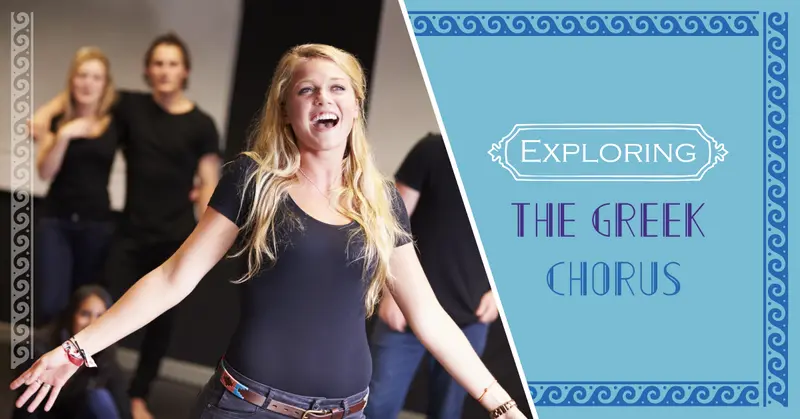
In Ancient Greek Theatre, there is an interesting similarity among the plays written during that time: there is always a chorus included. Nowadays most people would associate a chorus with musicals, but playwrights like Aeschylus, Euripides, and Sophocles included a chorus in their regular plays. The chorus consisted of a group of 12 to 50 players who spoke or sang their lines in unison, wore masks, and functioned as one actor rather than a large group of many performers. The purpose of the Greek chorus was to provide background and summary information to the audience to help them understand what was going on in the performance. They commented on themes, expressed what the main characters couldn’t say (like secrets, thoughts, and fears) and provided other characters with information and insights. Because Greek theatres were so large, the members of the chorus had to work hard to look and sound like one person. Their diction and lines had to be presented crisply and clearly so the entire audience could easily hear them. Their gestures were overly exaggerated. Frequently a chorus leader, called a coryphaeus, would aid with comprehension. Here’s an excerpt of a speech performed by the chorus in The Trojan Women by Euripides: In Salamis, filled with the foaming of billows and murmur of bees, Old Telamon stayed from his roaming, Long ago, on a throne of the seas; Looking out on the hills olive-laden, Enchanted, where first from the earth The grey-gleaming fruit of the Maiden Athena had birth; A soft grey crown for a city Belovèd, a City of Light: Yet he rested not there, nor had pity, But went forth in his might, Where Heracles wandered, the lonely Bow-bearer, and lent him his hands For the wrecking of one land only, Of Ilion, Ilion only, most hated of lands! It continues on for three more sections but even this small sample illustrates the challenge of the lines. It shows how focused and precise the Greek chorus had to be to be able to speak these lines in unison and to be clearly understood by the audience! How can you apply this to the classroom?Here’s an exercise to try in the drama classroom which will help students to understand and explore the Greek chorus. Divide students up into groups (try for groups of at least 5-6, even though traditionally the smallest chorus was 12 people). Give each group a mundane, everyday activity like: • Brushing their teeth • Packing a lunch • Choosing an outfit to wear • Walking to school • Feeding the dog Have the students work together to write and present a Greek chorus piece that narrates the actions of the mundane activity. They must write at least six full sentences in modern language or a more poetic style. Whatever style they choose, encourage them to be extremely detailed and descriptive. Here’s an example, using the teeth-brushing suggestion: Morning time, and Sarah awakes! She opens her eyes and rubs out the sleep of a dreamless night. Slowly, slowly she rises from her bed and stumbles to yonder bathroom. Reaching deliberately towards the toothbrush That promises clean teeth that resemble white pearls. Toothpaste, with claims of minty freshness Is spread upon the bristles in haphazard fashion. One by one, cleansing foam envelops each tooth. A rinse of clear, cool water and Sarah is nearly ready to face the day. Fun, right? Once the chorus is written, one student will act as protagonist (first actor) and perform the actions that the rest of the students (as the chorus) will narrate, using exaggerated actions. The chorus will recite the piece they created, working on speaking clearly and with great diction, to illustrate what the protagonist is doing. Have the groups present their performances in front of the rest of the class. To take the performance a step further, students could create masks or simple costumes to go along with their presentations. For example, in the tooth-brushing scenario, the protagonist might wear pajamas and a sleep mask on their head, and the chorus might dress up as tooth fairies with wings and tiaras. Or perhaps make toga-like outfits out of comforters or colourful bedsheets. Get creative!
A play in pictures: Agatha Rex
Featured Plays

A play in pictures: Agatha Rex

Because I live in a small corner of Canada and my plays are often performed far away from me, I don’t get to see many productions. So I love it when a director or a teacher reaches out to let me know what they did with a play and how it went. Stacey Meisetschlaeger from Texas recently directed Agatha Rex with her middle school and had great succeeds with it.
Spread the Love: Agatha Rex – adapted by Lindsay Price from Antigone
Featured Plays

Spread the Love: Agatha Rex – adapted by Lindsay Price from Antigone

This week we spread the love for Agatha Rex, a retelling of Sophocles’ Antigone set in a modern-day high school.