📣SCRIPT SALE! Treat yourself to an easier Fall. Save 30% on 5+ perusal scripts with code SPRING30 before May 3 and head into summer stress-free.
History
Featured Plays
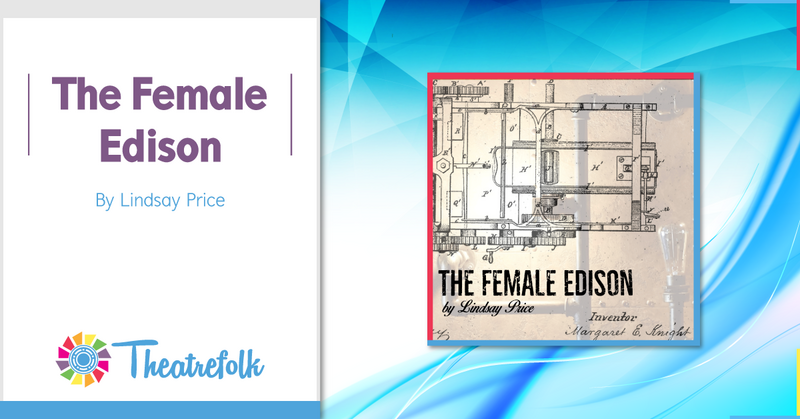
Theatrefolk Featured Play: The Female Edison
Welcome to our Featured Play Spotlight. The Female Edison by Lindsay Price is an incredible ensemble piece with something for everyone!
Margaret E. Knight was a 19th century inventor with two big but forgotten stories.
At 12 years of age, while working at a textile factory, she invented a part to improve the safety of a power loom. How did she not only get mill management to listen to her idea but implement it?
As an adult, she invented a machine to mass-produce flat bottom paper bags. This invention was eventually stolen from her so she hired a lawyer to take the case to court. The defense was that “there is no way a woman could have invented this.” How did Margaret persist and secure her place in the annals of invention?
NOTE: There are also two independent one-act versions of the script available that can both be performed without any knowledge of the other: Patterns & Power: The Female Edison and Failure & Fortitude: The Female Edison.
Let's hear from the author!
1. Why did you write this play?A lot of times I go down rabbit holes of research because of some observation that came across my world view. That's what happened which led me to Margaret E. Knight and her paper bag machine invention. There isn't a lot about her online, but everything I read made me excited to share her story theatrically.
2. Describe the theme in one or two sentences?Failure and fortitude are the touchstones for every inventor, but even more so for 19th century female inventors.
3. What's the most important visual for you in this play?I love seeing the 19th century machines come to life through actors. I knew, writing this for schools and student performers that any of the machines would have to be actor driven rather than actual set pieces. It took a long time in my research to figure out how to turn a power loom into three different action sets and how to turn Margaret's mass-produced paper bag machine into action. But I love the results.
4. If you could give one piece of advice for those producing the play, what would it be?There's a lot of ensemble work in this play and a lot of moving pieces as actors enter and exit. The more you practice transitions the smoother the flow of the piece will be. Also, don't be put off by the number of traditional male roles. It is my intention that the majority of the roles are played by the actors who best suited for the role regardless of their gender.
5. Why is this play great for student performers?It has everything! Some history, characters fighting and succeeding through great adversity - I mean, someone tried to steal Margaret's patent for the paper bag machine to the point that she had to go to court and get it back. In a time period when a married woman wasn't even allowed to put her own name on a patent, the fact that she won her case is remarkable. Further to that, there is so much ensemble opportunity in the play. You can really expand the cast size if you want.
6. Who is your favourite character in the play? OR Which character would you be in this play?Margaret all the way! I love her story. She had everything against her: no schooling, no desire to be "normal" in an era that really required women to be and act in a certain way, and in court, the man who stole her patent said that "there was no way a woman could have understood such mechanical complexities" And yet she still persevered.
7. What is your favourite line in the play?"I am not a cog in any machine."
Featured Plays
Theatrefolk Featured Play: Almost History: that whole space-time continuum thing by Treanor Baring
“You gotta study history
And know that it’s no mystery
Without the facts of every bit
You are doomed to repeat it.
Repeat it, repeat it, repeat it…”
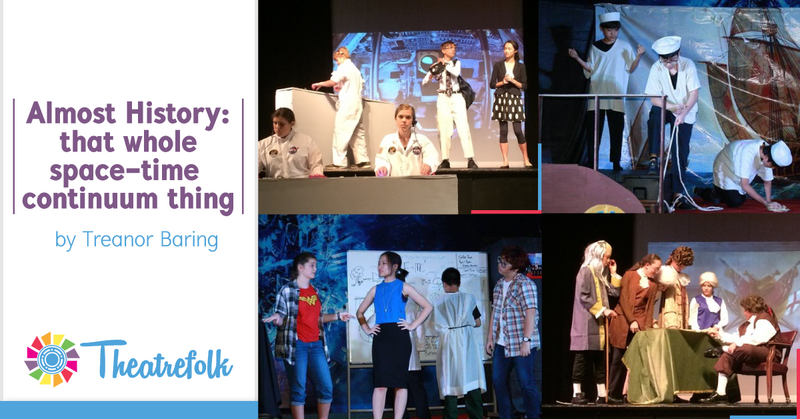
Welcome to our Featured Play Spotlight. Almost History: that whole space-time continuum thing by Treanor Baring immerses drama students into some of the great moments in American history. And they’ll have so much fun they just might want to repeat it again and again!
In a hilarious series of time-travelling misadventures, a Reporter and a Sidekick livestream from great moments in American history.
Despite the über-scientist Sidekick’s best efforts to keep the clueless Reporter out of trouble, they change the course of history and return to a comically chaotic present. Even Einstein and Marie Curie cannot undo the disastrous effects of their mishaps.
Eventually, they are able to save democracy and technology by restoring order to the “whole space-time continuum thing.”
Why did we publish this play?
The title gives you a pretty big hint about the tone of the play and that it’s not going to be your typical time travel experience! Add in a little dash of history and a lot of simple staging (you too can stage time travel) and you’ve got all the reasons why we published Almost History.
Let’s hear from the author!
1. Why did you write this play?
To celebrate some of the great moments in American history. And also because I have a quirky sense of humor and a very middle school sensibility when it comes to comedy.
2. Describe the theme in one or two sentences.
The synopsis is that a reporter and sidekick travel back in time to great moments in American history and end up creating chaos in the whole space-time continuum thing. The theme is that it’s important to learn history, but in a fun way.
3. What’s the most important visual for you in this play?
The reporter and the sidekick standing with their streaming equipment on the edge of the signing of the Declaration of Independence, the moon landing or Alexander Graham Bell’s workshop. They start as observers and end up as unwitting participants.
4. If you could give one piece of advice for those producing the play, what would it be?
Be flexible with casting. There isn’t a single character that can’t be played by a girl or a boy. I’m always available for questions.
5. Why is this play great for student performers?
It’s got slapstick comedy, with lots of running around on stage and goofy looks, but I also enjoy writing snappy dialogue. It has a large cast with interesting supporting characters and varying line length for all levels. Many of the characters can be doubled for smaller programs. And the characters are recognizable to middle schoolers. Teachers have told me their students love bringing, or seeing, the people they’re studying in history come to life, but not so seriously. School theatre directors have also told me they look for ways kids can be involved back-stage. The sound and light cues can be adapted to a program’s resources, and they give a chance for non-actors to be involved in the production.
Teaching Drama
A Picture Tells a Thousand Words: Cross-Curricular Drama Classroom Project
The phrase “a picture tells a thousand words” is pretty well-worn, yet the concept has proven true time and time again. Look at any picture that captures a moment in action – the words needed to explain it could go on for days. Some pictures hold many stories.
Three children sit in front of a pile of rubble. Who are they? Are they related? Where are their parents? What was the building before it was destroyed? What are they looking at? What happens next?
This concept makes pictures an excellent jumping off point for a cross-curricular drama classroom project.
Cross-Curricular Project: History Comes to LifeObjective: To apply dramatic techniques to a moment in history
Description: Students will work in groups to create a short scene. The jumping off point for the scene will be a photo that shows an unexpected moment in history.
Materials: Students will need access to the internet to find photos on their own, or you will have to find a variety of photos and present them to the class.
Instructions:
1. Divide Students into Groups
Depending on your class size, keep the groups small (3-4 people).
2. Choose a Picture
You can either have students choose their own photo or (if they aren’t allowed internet access) you’ll have to choose pictures for them and print them off.
The requirement for the picture is that it has to take place during a historical event (a war, an invention, a significant era like the Depression, a significant person like a world leader).
A few interesting sites that showcase unique historical pictures:
- 40 Must See Historic Moments
- 40 Rare Historical Photos
3. Brainstorm on the Picture
Have each group write down their impressions, ideas, comments, and questions about their chosen picture. Remind students not to think ahead to the final project just yet. Focus on responding to the picture. Also, reject nothing. Accept everyone’s thoughts on the picture and write them down. Brainstorming sessions go awry when students start to censor or judge ideas as they come in. The best method is to write everything down without judgement.
4. Write an Inner Monologue
Before they start working on their scene, give students a short monologue exercise. Have them choose a person in the photo, or (if there are no people) choose the photographer. Write a short, half-page inner monologue. What is this person thinking in this moment? What do they see? Who could they be talking to in their mind (a parent who’s not there, a loved one, an enemy, another person in the picture)? It’s always better when a monologue has a listener, even if that listener can’t hear what’s going on inside a character’s head!
This is an individual exercise. Once completed, have students share their monologues in their groups.
5. Decide the WHO, WHAT, and WHERE
Now that groups have a picture, brainstorm suggestions and a number of monologues. The first step in creating the scene is to come up with the who, what, and where. The criteria is as follows:
• Decide the WHO. Who are the characters in the scene?
• Everyone in the group has to be in the scene.
• The characters in the scene could be from the picture, but they don’t have to be. They could be watching the scene from behind “the photographer.”
• Identify the WHAT. What is happening in the scene? Remind students that they are illuminating the picture. What are the words that bring the picture to life?
• Identify the WHERE. Where does the scene take place? It might not be clear in the picture. Make sure the scene has a specific WHERE.
6. Write the Scene
Have students work together to write a 1-2 minute scene based on their WHO, WHAT, and WHERE. Students might need to do some additional research if the historical moment is unfamiliar to them.
7. Rehearse
Give students time to rehearse. Depending on the length of the project, this could simply be a well prepared staged reading, or it could be a memorized and assessed performance.
8. Perform
After each group performs their scene, show the rest of the class the picture they used. Ask students what they see in the picture and how the scene illuminated the historical moment.

Teaching Drama
Taking a Page from Hamilton’s Book: Using Theatre to Share and Celebrate History
Unless you’ve been living under a rock, you’re hyperaware of Lin-Manuel Miranda’s musical Hamilton, which has won Tony Awards, a Grammy, the Pulitzer Prize, and the accolades of everyone from Barack and Michelle Obama to Beyoncé and Jay Z. What is especially fantastic is the #EduHam program, which has brought thousands of high school students to the Richard Rodgers Theatre in New York City. This program gives students the chance not only to see the production, but also be able to go up onstage and perform their own raps based on themes they learned in American history class. (How cool is that?!)
Why not a take some inspiration from Lin-Manuel and use theatre as a medium to share and celebrate history in your own classroom? This could be a great cross-curriculum project with the history department at your school. As a starting point, chat with the teachers in the history department to find out what subjects they’re focusing on this semester.
There are so many areas of history that the possible topics are virtually endless:
• Local History (I live in London, Ontario, Canada, so perhaps I might get inspired by the story of the disappearance of Ambrose Small, owner of the Grand Theatre in London, or an account of Guy Lombardo, the famous bandleader.)
• Provincial or State History (For Ontario residents, how about the forming of Upper and Lower Canada in 1791, Alexander Graham Bell inventing the telephone in Brantford, Ontario, or Agnes Macphail becoming the first woman elected to the House of Commons?)
• National Historical Events or People (Canadians could write about Laura Secord, James Naismith, Terry Fox, Sir John A. Macdonald, Lucy Maud Montgomery…or even events like when Canada became a country in 1867!)
And these are just a few suggestions for Canadian history classes. What suggestions could you come up with from where you live? Imagine what students might be able to explore through every era of history. The real trick will be to narrow down the topics.
The important aspect will be for students to find a connection between their chosen topic and themselves (either through the topic itself or through the medium by which they create a piece). Perhaps they will choose to focus on the life of Terry Fox, because they have a family member who fought cancer. Or maybe they are interested in unsolved mysteries, so they decide to focus on Ambrose Small. Perhaps students will discover a famous historical person that either grew up in their hometown or is distantly related to them.
The connection might also come through the style of theatre in which they choose to present their topic. Maybe they will go the LMM route and present a theatrical rap based on a historical figure. Or (if rap is not to their liking) what about a mime piece about a local invention, or a full-out classic musical theatre Song and Dance piece about a specific event?
Students should choose a style of theatre that really speaks to them and really make it their own, whether or not they connect with the historical event or person. A project like this provides a lot of freedom to explore various types of theatrical presentations, whether it be through puppetry, tableaux, monologue, musical theatre, radio plays, or one of the other many, many types of theatre!
If this seems like a daunting task, take heart. It took Lin-Manuel Miranda over six years to create Hamilton in its entirety! So, get laser-focused. Divide students into groups of 4-5, and challenge them to create a theatrical presentation with the following rules:
• One moment in a historical event of their choosing,
• In the style of theatre of their choosing,
• To be presented to the class with some sort of visual representation to establish the time period (costumes, props, set pieces, puppets, etc.),
• In a performance presentation that lasts four minutes or less.
Whatever the topic or method of presentation, the goal is the same: to get students excited about history, to have them connect with the material in an engaging and interesting way, and to encourage students to think about and present the material in a fresh, original way. Who knows what cool new creations will arise from this exploration – you may have a future Pulitzer winner in your class!
Kerry Hishon is a director, actor, writer, and stage combatant from London, Ontario, Canada. Explore her blog at www.kerryhishon.com.

Classroom Exercise
Writing Your Research: A Cross-Curricular Exercise
Cross-curricular projects are awesome in theory, especially in the drama classroom. They are a great way to demonstrate comprehension by taking information in one form and applying it to another.
Such projects don’t always work in practice. Information does not always translate well into theatre. It’s not dramatic to have characters recite facts and statistics in a stiff way. “Oh dear brother, this is 1941. We would never wear such stockings. There’s a war on, you know!” No one talks this way. It takes work and skill to turn information into a play.
Bottom line, the final product is a piece of theatre – be it a monologue, a scene, or a full play. The final product is not a textbook or an informational brochure. However you approach the work, theatre has to come first.
How do you do this?
Here’s how you can ease the transition from information to drama.
Focus on CharacterFind the characters at the heart of your topic. Determine how they feel. Audiences don’t connect to buildings, locations, facts, or events. But a natural connection emerges when a character is having an emotional reaction. An audience doesn’t have to live through or experience the topic personally to connect to a character’s emotions.
Don’t get Overwhelmed by ResearchIt is so easy to become overwhelmed by the amount of information surrounding a topic.You know all these details and want to include as much as possible because you think you’re doing the topic a disservice otherwise.
Sometimes it’s better to put research to the side and let the facts come to the surface as they may. Particularly during the writing process. Don’t worry if you get things wrong initially, that’s what rewrites are for. Read the information, digest it, and then put it to the side while you write. This way you have a better chance of keeping the focus on the play rather than the research.
Show, Don’t Tell Your StoryThat is the number one rule of playwriting. Show don’t tell. We don’t want to hear about the great fire of 1939, you have to find a way to show the fire. We don’t want to hear a narrator telling us something, we want to see a character reacting to a situation. Create images with your information. Audiences do not connect with facts and events, audiences connect to characters within those facts and events.
ExerciseUse this practice exercise to get students accustomed to focusing on character and leaving facts to the side.
Materials needed
• Omaha Beach Info Sheet (download the sheet below!)
• Pen/Paper
Instructions
• Hand out the info sheet on the WWII D-Day Invasion at Omaha Beach.
• Direct students they have one minute to study the sheet.
• At the one minute mark, direct students to turn the sheet over. They are not going to refer to the sheet while they write.
• Direct students that they will write a monologue inspired by Omaha Beach.
• At the top of the page direct students to write down the following:
• The character in the monologue
• Who is character talking to?
• The location.
• Students write the monologue. Remind them they can’t refer back to the sheet, and they’re just to let whatever information they remember come out in the writing. Also remind students to focus on bringing the character and the character’s emotions to life.
• Students share their monologues.