Facebook Pixel Skip to main content

📣SCRIPT SALE! Treat yourself to an easier Fall. Save 30% on 5+ perusal scripts with code SPRING30 before May 3 and head into summer stress-free.

Social Emotional Learning

Why Kindness Matters in the Drama Classroom (And How to Encourage It)
Teaching Drama

Why Kindness Matters in the Drama Classroom (And How to Encourage It)

If you’ve ever been part of a theatre production, you know that drama isn’t just about acting — it’s about teamwork, trust, and putting yourself out there. That’s why kindness in the drama classroom isn’t just nice to have; it’s essential. Think about it: theatre requires students to take risks. They have to speak in front of others, step into unfamiliar roles, and sometimes even make themselves look a little silly. That’s not easy! But when students know they’re in a supportive, kind environment, they’re much more willing to try, fail, and try again. So how can we, as drama teachers, actively cultivate kindness in our classrooms? Here are a few simple but effective ideas: 1. Make encouragement the norm.• Start class with a “shout-out” circle where students recognize something great a classmate did. • Encourage students to give positive feedback before offering constructive criticism. (A simple “I loved how expressive you were!” goes a long way.) 2. Model kindness in your feedback.• When giving notes, focus on growth rather than just what went wrong. • Use “and” instead of “but” when offering suggestions: “Your character choices were strong, and if you add a bit more energy, it’ll be even stronger.” 3. Foster a “we, not me” mindset.• Remind students that theatre is a team sport — every role, onstage or off, matters. • Have students switch roles occasionally so they appreciate all aspects of a production. 4. Create a no-mocking zone.• Establish a rule that everyone gets to try things without fear of being laughed at (unless it’s intentional comedy!). • Call out unkind behavior gently but firmly. Drama class should be a place where students feel comfortable being brave. 5. Celebrate effort, not just talent.• Applaud students who take risks, even if the result isn’t perfect. • Acknowledge growth and improvement, not just natural ability. When kindness takes center stage, everything in the drama classroom becomes better: students feel braver, performances improve, and the whole experience becomes more fun. After all, theatre isn’t just about putting on a great show; it’s about building a great community.
Closure Practices for the Drama Classroom
Teaching Drama

Closure Practices for the Drama Classroom

What is a closure practice? A closure practice is a way for students to separate the work done in drama class or rehearsal from their everyday life. When working on intense exercises or scenes in the drama classroom, the body doesn’t know the difference between the made-up stress that students are performing and real-life stress. So it’s important that students have tools to prevent taking heavy feelings with them after completing the work in the drama classroom. Closure practices can be done individually, with scene partner(s), or as a full group. Different students might prefer to do closure practices differently, depending on what work they did that day and who they did it with. Closure practices aren’t required, nor do they have to be long or complicated. Again, what students might need could vary from day to day. Here are some simple closure practices you and your students can explore: • Check in with your students to see how they’re feeling. They can rate how they’re feeling out of 10 — 1 being awful and 10 being amazing. • Release energy. Energy and tension can build up in the body during intense moments, and it’s important to do something to release it so students aren’t carrying those feelings with them. Physically shake it out, clap hands, drum on the floor, or put on some music and dance it out. • Lead students in a brief guided meditation where they “take off” their characters like a coat, and leave any potentially stressful feelings or situations behind. Leave the character in the drama classroom. • Thank your students for their work, and have them thank their scene partners for being brave and vulnerable and taking risks. • Try grounding exercises. Have students sit or lie down on the floor, and imagine roots coming out of their bodies into the ground below them. Have students imagine any negative or heavy feelings melting out of their bodies and into the ground. Check out some other mindfulness exercises here. • Do some box breathing (breathe in for four counts, hold for four counts, exhale for four counts, pause for four counts, repeat) or other breathing exercises. Or, have students breathe in for four counts and exhale, yawn, or sigh for six counts, repeating as necessary. • Take a few minutes at the end of class to journal or free write any feelings, questions, or thoughts that arise. Depending on how they’re feeling afterwards, students may wish to keep the notes or crumple up and discard the paper. Feel free to adapt these suggestions or create new closure practices that work for your students. Share them with us too! You may not need to employ closure practices every day, but it’s good to have these ideas handy when the need arises. Ask your students how they could apply these practices to other areas of their lives outside the drama classroom as well.
An Introduction to Consent in the Drama Classroom
Teaching Drama

An Introduction to Consent in the Drama Classroom

Consent can be a touchy subject in the classroom. Many students immediately think that consent refers to intimacy, such as embraces or stage kisses. While that is an important part of consent in the drama classroom, it encompasses much more than that. Consent in the drama classroom creates a safe and respectful environment, and is a big part of social and emotional learning. It can apply to incidents in drama class, as well as a multitude of real-life situations. Here’s a brief overview of this vast, evolving, and important topic: 1. Explaining consent to your studentsConsent, simply put, means permission for something to happen or be done. Consent is specific, informed, and flexible — meaning it can change or be withdrawn. You can introduce the topic of consent by discussing with your students how they’d ask a fellow student to borrow an item of theirs. They can’t just go into that student’s backpack and grab the item — they have to ask first, and wait for the other student’s response. If it’s yes, great! If it’s no, then that’s that. Or, there might be conditions involved. There are many additional things to consider — check out the download below for more. This is a simplified explanation of how consent works. Try having your students role-play the interaction above. What are their thoughts afterwards? 2. BoundariesWhat are students’ physical and mental boundaries? Are they comfortable with the content of the lesson or the scene you’re studying in class? We don’t always know what experiences students have been through that could make certain content upsetting. For example, a student who recently had a death in the family may have difficulty studying a play with themes of grief. Or, they may be comfortable reading a scene in which a character dies, but they don’t want to play that role onstage. Boundaries vary from student to student, and oftentimes we don’t know what our boundaries are until they’re pushed. In these moments, it’s important to be flexible and compassionate, so students can work through their feelings. 3. Bodily autonomyBodily autonomy refers to students’ ability to decide what happens to their body without outside influence. In drama class, we use our bodies to tell stories. We often engage in hands-on work, using exercises, games, and scenes that involve physical touching, such as holding hands. Do students not want others to be near or touch certain parts of their body (or to touch them in general)? They may also feel uncomfortable in a particular costume piece if it is too short, tight, or revealing. Can you modify the actions of the exercise, the movements of the scene, or the garments to respect students’ boundaries? 4. Power dynamicsAre your drama students comfortable speaking up to their peers? Students may say yes to their peers on the outside, but mean no on the inside. Can you tell the difference? As well, if a student is in a leadership position (such as assistant director or stage manager), does that make it easier or more difficult for other students to speak up to them? Furthermore, can your students speak up to you? Teachers hold a lot of power, especially if they’re also directing the show. Are your students comfortable telling you no, and are you comfortable with hearing no? What feelings arise when a student says no to you? Do you feel confident, defensive, proud, irritated, confused, something else? Allow yourself time and grace to reflect on this. As our students learn about consent, boundaries, bodily autonomy, and power dynamics, we teachers are also learning and breaking our own previous patterns. It is not uncommon for feelings to arise when working on consent — after all, many of us are also healing from previous hurts and traumas. Be gentle with yourself, and be proud of the progress you are making. Additional Resources: • #MeToo in the Drama Classroom • Creating a Safe Rehearsal Space • Creating a Safe Drama Classroom • Safety Concerns in Distance Learning
Plays for Social & Emotional Learning in the Classroom
Teaching Drama

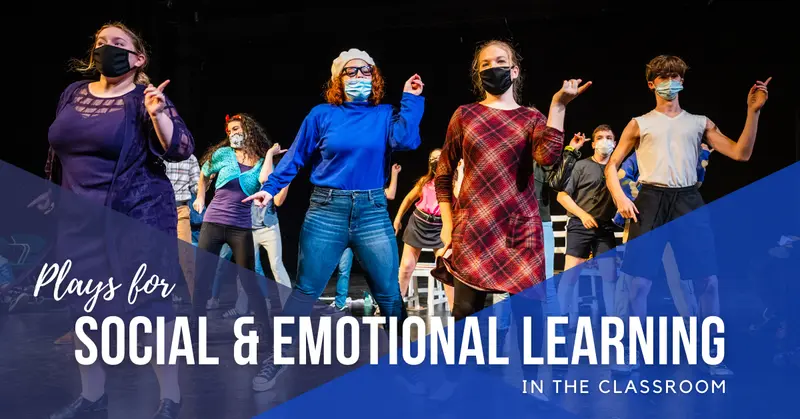
Plays for Social & Emotional Learning in the Classroom

The drama classroom has always promoted skills and lessons that are based on the foundation of social and emotional learning (SEL). Self-awareness, self-management, social awareness, relationship skills, and responsible decision making provide students with important life skills: empathy, collaboration, communication, developing and maintaining relationships, time management, and more. Every drama class already incorporates many of these concepts into daily lessons through critical thinking exercises, character analysis projects, collaboration activities, problem-solving challenges, and self-reflections. If you’re looking for new ways to incorporate SEL into your classroom, we’ve got a selection of fantastic plays for production or classroom study. These plays make a great class project activity and can be used to introduce SEL to your students or deepen their understanding and awareness. Plus, many of them come with free Classroom Study Guides, complete with pre-read questions and activities, close reading analysis, and post-read activities, to provide an in-depth theatrical learning experience. Check out all of our plays to help bring SEL to your classroom here — available in digital PDF and printed scripts.
Theatrefolk Featured Play – A Recipe of Me by Kate Kilpatrick
Featured Plays

Theatrefolk Featured Play – A Recipe of Me by Kate Kilpatrick

*Welcome to our Featured Play Spotlight. * A Recipe of Me by Kate Kilpatrick is an incredible ensemble play with authentic middle school characters for middle school students. We see people all the time but don’t always know their stories. A Recipe of Me is great for social-emotional learning and understanding others. Leah and her siblings are relegated to the kids table in the kitchen AGAIN for Thanksgiving at Grandma Lucy and Grandpa Elliott’s house. Worse, they’ve had their phones taken away. This leads to the siblings searching the cupboards for snacks. What they come away with is Grandma Lucy’s secret family recipe box. They think they’re going to find juicy gossip. Instead, they find heartfelt stories about their family told through recipes. Stories they never knew. A beautiful look into the world of a family rooted in love and food. Food is the language that everyone can speak. This play was written specifically for middle school performers and won top honors at both the Florida Jr. Thespians District and State levels. Why did we publish this play? A Recipe of Me is a play specifically written with middle school aged characters for middle school performers, and we’re always on board with that. Further, it’s a thoughtful, engaging look at how we see other people – especially the people we see all the time like our family. A beautiful show with dynamic characters AND easy to stage. The original production had a card table with five chairs – the rest was taken care of by an ensemble and the imagination. Let’s hear from the author!1. Why did you write this play? This play started with a passion project called Come to the Table, where we took a cast of middle school students to an assisted living facility in their community and had them interview the seniors about their favorite family recipes and food traditions. I knew I wanted to write a play about the importance of food and tradition in family cultures, and how food – similarly to theatre – is a universal way to bring people together. I always knew I would use elements of the interview transcripts while writing the play, but I also wanted to prioritize writing something for middle school students where they actually got to play middle-school-aged characters; from the beginning, I knew I didn’t want middle schoolers playing seniors. I believe A Recipe of Me authentically captures the love and respect cultivated in our interviews in a creative, fresh perspective to which middle school performers can easily relate. 2. Describe the theme in one or two sentences. Food is love. Family is love. Food is family. 3. What’s the most important visual for you in this play? I think the use of the ensemble allows so much room for play and creativity throughout. Whenever there is a breakout Recipe of Me moment, there is an ideal moment for devising tableau, pantomime, and other collaborative unique to each production. For me, those ensemble moments are what breathe life and detail into the story. 4. If you could give one piece of advice for those producing the play, what would it be? Use this script as a way to inspire young performers to connect with their own family food traditions and stories. The more you can get them invested into the story, the stronger the play will be. Our auditions for the show (before the script was even written) was asking the students to prepare a story about food in their family (Have you ever been cooking and something went wrong? Who taught you how to make your favorite recipe? etc.), and at our very first rehearsal, students made their own Recipes of Me and shared them with the cast and crew. There is so much flexibility in this story – find the heart and playfulness that resonates with you and your cast. 5. Why is this play great for student performers? Simply put, because it was written for student performers. Students helped me devise and revise the script. Even the characters that are from different eras are portrayed as their younger, middle-school selves. It doesn’t ask young performers to try and put themselves in the shoes of adult characters – it was truly intended for young people. 6. Do you have any advice for people looking to perform this play online or socially distanced? Utilize your ensemble! You can easily create striking stage imagery with a distanced ensemble. Physical closeness will not make or break this story. For those attempting to stage it online, I would say the same – think of ways you can use your full cast when supporting the break-out Recipe of Me moments throughout the play.
Post-Exercise Exercise: Rate Yourself
Classroom Exercise

Post-Exercise Exercise: Rate Yourself

One of the five categories of social and emotional learning is self-awareness. For students, part of being self-aware includes being able to identify their own levels of effort in exercises, games, and performance assignments in drama class, and then being able to rate and assess their efforts. Do they think they’re giving their best effort, or are they just doing the bare minimum to squeak by? Start by observing your class while they’re doing active group work, such as preparing and presenting a group scene or tableau. Look over any evaluations or rubrics you’ve filled out for your students in the past, specifically relating to the effort they demonstrate in class. This will give you a baseline idea of what your students’ levels of effort appear to be. Next, introduce the idea of being aware of effort with a class discussion. Here are some questions to get your students thinking: • How can you tell if someone is giving their best effort, regardless of their talent or skill level? • Why is it important to always give your best effort? • Is your best effort always going to be the same? Why or why not? • What is the difference between your assessment of your own effort and others’ assessments of your effort? • What are the long-term results of continually giving only the minimum effort? Then, after your next group game/exercise/performance assignment (or rehearsal run-through), ask your students how they thought it went. You might ask one of the following questions: • If you had to rate that performance out of ten, what would you rate it? (You can either have students call out a number or hold up their fingers.) • Was that performance ready for an audience? • How would you feel if another class/another teacher/the principal saw that performance? Always follow up with a clarification question: Why did they choose that rating? Why do they (or do they not) think the performance is audience-ready? What do they think the group needs to do to make the work better? Give your own rating of the group’s effort out of ten. Compare and contrast your students’ feedback with your own. See if you and your students are on the same wavelength in terms of their perceived effort. Remind students that you’re seeing a different perspective of the moment: they’re doing the work, while you are observing the work. This exercise can be used after any group performance work, or as a periodic check-in during the semester or term. If your students seem shy or hesitant to rate themselves verbally in class, have them fill out a reflection or exit slip to help them practice their self-awareness. The exit slip can be as simple as “Rate your effort in today’s exercise out of ten” or “Name one thing you can do to improve next time.” Or, use the more detailed reflection found below.
Character Study: Self-Awareness
Classroom Exercise

Character Study: Self-Awareness

The following exercise helps students learn self-awareness (which is one of the categories of social and emotional learning) and apply it by analyzing characters in a play that they are currently studying. Seeing fictional character examples will help students gain a deeper understanding of the concept of self-awareness. This exercise can be done as a class, individually, in partners, or in small groups. It can be done in person, virtually via distance learning, or as a written homework assignment. 1. Introduction: What does it mean to be self-aware? What traits does a person who is self-aware possess? As a group, have students suggest various attitudes or characteristics that people who are self-aware display. These might include: • Identifying the emotions you’re feeling • Understanding the emotions you’re feeling and the thoughts you’re thinking • Understanding the connection between your thoughts, feelings, and behaviours • Having a realistic perception of yourself • Knowing your strengths and weaknesses • Knowing your limits • Having self-worth • Demonstrating a growth mindset and willingness to learn • Being able to reflect on your experiences and identify what you’ve learned • Believing that you’re capable of doing what it takes to achieve a goal • Recognizing your own coping mechanisms • Defining your own beliefs without being influenced by others Optional discussion: Do you or someone you know have these traits? How does self-awareness affect you in your everyday life? How can you improve your own self-awareness? Give examples. 2. Using a play your class is currently studying, have students identify one character who displays self-awareness. Give proof from the text. Answer the following: How does this character’s self-awareness benefit them? If students are having trouble finding a character that is self-aware, remind them that it’s a rare person who is fully self-aware all the time. Look for moments of self-awareness in the character to start. 3. Next, have students identify one character that lacks self-awareness. Give proof from the text. Answer the following: How does this character’s lack of self-awareness hinder or harm them? 4. Bonus Question: Are there any instances in which a character’s self-awareness hinders or harms them, or a character’s lack of self-awareness benefits them? Give proof from the text. 5. Students will complete and submit a final reflection (click below).
Game: Challenging Negative Thoughts (SEL Self-Awareness)
Classroom Exercise

Game: Challenging Negative Thoughts (SEL Self-Awareness)

Negative self-talk is so common and can be very difficult to overcome, not only for students but also for teachers. It’s easy to fall into the trap of berating ourselves over mistakes and telling ourselves we aren’t good enough. We would never speak to a friend or even a stranger like that, so why do we do it to ourselves? If your students need a bit of a pick-me-up, the following exercise can help them become aware of their own negative self-talk and dismiss it. Instructions: 1. Individually, have students write a list of up to three negative things that they have thought or said about themselves. Allow them to share some of the negative thoughts and write them on the board if they want to. (This can help students see that others may have had similar negative thoughts about themselves, and that they aren’t alone.) • Another suggestion is to have students write out their negative thoughts on Post-it Notes and submit them to you so you can display them anonymously where everyone can see. Then students can see that others have similar negative thoughts but no one has to volunteer their thoughts. 2. Take a moment to think about this negative inner voice in your head. RuPaul (from RuPaul’s Drag Race) calls this negative voice the “inner saboteur.” Alberto from the movie Luca calls it “Bruno.” Give your negative inner voice a name. It can be anything except for your own name. 3. Come up with a character for the negative inner voice. What do they look like? What does their voice sound like? How do they move? If time permits, have students draw a sketch of the character, have them get up as a group and move around the space as their character, or have them partner up and try out different voices for their character. 4. How would you tell your negative voice to be quiet or stop putting you down? Make up a phrase. Alberto says “Silenzio Bruno!” when his negative inner voice talks to him. For example, students could say “Thanks for your input,” “That’s not true,” “Stop lying,” “Be quiet,” or any other phrase that dismisses the negative thought. 5. Have everyone stand up. Choose a negative thought to say. At the same time, have students say their thoughts out loud in their negative inner voice’s character voice/persona. 6. Then, students will stand up straight in a strong position — standing tall, feet flat on the floor, shoulders back, chin up. At the same time, in a powerful voice (their own), they will say the phrase that they chose to dismiss the negative thought. Feel free to repeat this step as many times as you wish. 7. Have students make a big show of scrunching up their original lists of negative thoughts and throwing them away. 8. Students will respond to the exit slip below.
Change the Decision: Analyzing Character Choice
Classroom Exercise

Change the Decision: Analyzing Character Choice

In this article, we’re focusing on responsible decision making, which is one of the five areas of Social and Emotional Learning (SEL). If the concept of SEL is new to you, check out this article for a basic overview: Social and Emotional Learning in the Drama Classroom: What Is It?. Decisions are often what drive the action in plays. Alice decides to follow the White Rabbit down the rabbit hole. Romeo decides to gatecrash the Capulets’ feast with Benvolio and Mercutio. Wednesday Addams decides to invite her new (and normal!) boyfriend and his parents to meet her creepy, kooky family. One major decision may affect a number of characters and situations within the play, and a really intriguing decision will keep the audience on the edge of their seats, waiting to know what the fallout will be. But what if the character makes a different choice than what happens within the text? The following exercise challenges students to first identify and analyze a big decision made within the text by a character, and then to think creatively about what the characters might have done differently. Have students respond to the following questions, either in class as a discussion, or as a written assignment. Students may work individually, in pairs, or in small groups. You may assign a particular scene or moment for students to analyze, or have students select their own play and choose the moment they are going to analyze. 1. What was the incident that occurred in the script that caused the decision? When did the incident occur? What characters were involved? 2. What were the options that the character had to consider? How many options were there? Use specific quotes from the text. 3. What were the known pros and cons of this choice, if any? 4. What did the character ultimately choose to do? Write down the choice as it appears in the text, or your best approximation. 5. Was it their choice to make? Did another character or situation influence their choice? Was the character forced into the choice, or did they make it on their own? 6. Was the choice the character made an ethical one? Why or why not? 7. What were some options that weren’t in the text that they could have considered instead? 8. What would have happened had the character made a different choice? Would the show have been the same, or would it have ended differently? You can even go further with this exercise and have students create and perform their own scenes in which the characters make a different choice than what appears in the text. It’s fascinating to see where your students’ imaginations take them!
Round-Up: Theatre Games for Building Relationships
Classroom Exercise

Round-Up: Theatre Games for Building Relationships

In this round-up post, we’re focusing on relationship skills, which is one of the five areas of Social and Emotional Learning (SEL). If the concept of SEL is new to you, check out this article for a basic overview: Social and Emotional Learning in the Drama Classroom: What Is It?. Here are ten theatre games that help students develop relationship-building skills: five for building relationships between students in the drama classroom and five for building and developing relationships in character. Each game has an additional exit slip question that you can use for a post-game written assignment or verbal discussion topic, to help students further delve into the topic of building relationships. Building Relationships in the Drama ClassroomThe Human Knot • Students must work together to untangle a full-class knot. • Exit slip question: How does this game help to build relationships in the drama classroom? The Negotiation • Students must work together to plan and present on a topic in a short amount of time. • Exit slip question: Describe your relationship with your teammates during this game. Were you a leader, a follower, spoken over, a collaborator? (Your relationships with different teammates might be different.) How did that make you feel? Three Games to Help Students Play to the Audience • These three simple games will help students learn audience awareness and theatre etiquette: Trapdoor, Upstage/Downstage, and Act It Out. • Exit slip question: What is the relationship between actors and the audience? How can you use the skills you practiced in this game to improve that relationship? Three “Get To Know You” Games • These three simple games will help you and your students get to know each other: The ABC Name Game, Move Yer Butt, and Mixer. • Exit slip question: How did this game help you develop/improve your relationships with other students? Three Things in Common • This game will help students get to know each other better, beyond surface commonalities. • Exit slip question: What was something unexpected that you learned you had in common with someone today? What else would you like to learn about that person? Building Relationships in CharacterCombining Skills • While students play characters with different occupations, they need to create a working relationship to solve the problem at hand. • Exit slip question: What were the relationships between your character and your team members’ characters? How did you build those relationships during the scene? Imposter • Students play experts in the same profession working together, while discovering that one member of the team is an imposter. • Exit slip question: For the experts: How did your relationship change when you realized one of the team members was an imposter? For the imposter: How did you try to relate to the team of experts? Job Interview • Student A interviews Student B for a job, but Student B doesn’t know what the job is. • Exit slip question: Who had more power in this relationship? Did the power dynamics change during the scene? How did you feel being more/less powerful than your scene partner? Muted Conversations • Two students act silently while two other students play their voices. • Exit slip question: Was it easier for you to relate to your scene partner or your voice partner? Why? Taking Away the Script • Students work in groups on a scene. Partway through the rehearsal, students are informed that they cannot use any words to perform their scene. • Exit slip question: How can you effectively show and develop the relationship between characters onstage without using words?
There’s Always More to the Story: Finding Empathy for the Villain
Classroom Exercise

There’s Always More to the Story: Finding Empathy for the Villain

In this article, we’re focusing on social awareness, which is one of the five areas of Social and Emotional Learning (SEL). If the concept of SEL is new to you, check out this article to get a basic overview of it: Social and Emotional Learning in the Drama Classroom: What Is It?. Social awareness focuses on the ability to understand the perspectives of and empathize with others, including those from diverse backgrounds, cultures, and contexts. Social Awareness is all about demonstrating empathy and compassion for others, acknowledging and appreciating the views and feelings of others, and cultivating respect and understanding of others. This is so important, particularly in the drama classroom, because theatre is all about students from all walks of life coming together to create theatrical art. We’re jumping into this with both feet and exploring a challenging topic: finding empathy for villainous characters. We’ve talked about theatrical villains in the past on the Theatrefolk blog, in the posts The Other Side of the Story: The Villain and Creating Conflict with the Supervillain. Some students are resistant to studying or portraying villains because of their own personal moral compasses or beliefs. When approaching villainous characters, challenge students to delve deep into how the villain ended up that way. There’s always more to the story than meets the eye. Try the exercises in the linked posts with your students, and help them peel away the layers of the villainous characters to discover something they can empathize with. Here are some discussion questions that can help your students along this path: • What is the difference between empathy and sympathy? • What does it mean to be empathetic? • What does the saying “to walk a mile in someone’s shoes” mean? Have you ever done this? Could you do this for a villainous character? Why or why not? • Does empathizing with someone’s point of view mean you have to agree with them? • What does the phrase “pushed to the breaking point” mean? How does this relate to a particular villain? Have you ever felt this way? What caused that feeling? And try the following exercise with your students: Many villains have a moment in their lives where a major event occurs that triggers their descent into villainy. Think about a particular villainous character (from a play or musical, movie, book, comic, etc.) and identify the major event. • What might have happened to the villain had that event not occurred? What might their life be like? • What if the event had happened to someone else (e..g, the story’s hero, a sidekick, a member of the villain’s family, a random stranger)? What might have happened? • In small groups (three to four students) write a brief scene illustrating one of the following: • A day in the life of the villain had they not turned to villainy • The event that triggered the villainy happening to someone else • The hero and villain in a stand-off, with the villain explaining their descent into villainy and the hero starting to demonstrate understanding • If time permits, perform the scene.
Self-Management in the Drama Classroom: Plan, Execute, Reflect
Classroom Exercise

Self-Management in the Drama Classroom: Plan, Execute, Reflect

In this article, we’re focusing on self-management, which is one of the five areas of Social and Emotional Learning (SEL). If the concept of SEL is new to you, check out this article to get a basic overview: Social and Emotional Learning in the Drama Classroom: What Is It?. Self-management is the ability to manage one’s emotions, thoughts, and behaviours in different situations effectively, and to achieve one’s goals and aspirations. This includes concepts such as taking responsibility and ownership for your actions, developing coping strategies, prioritizing, time management, demonstrating initiative, and goal setting. These are all important skills for students to develop in order to succeed both in and out of the drama classroom. Here are some questions you can ask your drama students to get them thinking about different aspects of self-management. You can use them as journal prompts, exit slips, or classroom discussion starters: • How can you demonstrate responsibility in the drama classroom? • How do you keep track of your responsibilities on a daily/weekly/monthly basis? (Our blog post Theatrical Time Management for Students) might be helpful for this question!) • You have a big soccer game the day before an important scene presentation in drama class. How will you prepare for both events? • On Monday, you are assigned a monologue to memorize and present on Friday. How will you use your time most effectively? • You have several big assignments all due around the same time. How do you deal with the potential stress? Then, try the following exercise with your students: Plan, Execute, Reflect. If possible, start this exercise on a Monday. 1 Have students make a list of all their responsibilities for that week. Think about school assignments, tests, after-school activities, part-time jobs, chores, family events, etc. 2. Then, using the provided weekly template (click the link below!), have students write down all their responsibilities for that week, when these responsibilities happen, and any due dates. 3. Have students complete the Start of Week Plan questions: • What’s my #1 priority this week? • How will I ensure that I complete my #1 priority? • What’s one thing I can do to reduce stress this week? 4. If necessary, break bigger tasks into smaller chunks. For example, if students have a scene presentation on Thursday, what do they need to do on Monday, Tuesday, and Wednesday to prepare? 5. On Friday, have students respond to the End of Week Reflection questions: • What went well this week? • What didn’t go so well this week? • What can I do to prepare myself for success next week? You can tie this in with more questions about how this exercise could benefit people in various theatrical professions, or how they can adapt it to their use. How could a stage manager use the template? How can planning their week benefit a professional actor? Why is it important for a lighting designer to have good time management skills? Why is it important for us (drama students) to develop these skills now?
Cultivating Self-Awareness in the Drama Classroom
Teaching Drama

Cultivating Self-Awareness in the Drama Classroom

We’re delving more deeply into the five areas of Social and Emotional Learning (SEL). If the concept of SEL is new to you, check out this article: Social and Emotional Learning in the Drama Classroom: What Is It?. The first area of SEL we’re focusing on is self-awareness. Self-awareness focuses on recognizing and understanding one’s own emotions, thoughts, and values, and identifying how they influence behaviour. Developing self-awareness helps students identify their own core values, strengths, and self-worth, as well as their own challenges and limitations. Self-awareness challenges students to demonstrate honesty and integrity, and examine prejudices and biases they might hold. Self-awareness can be challenging for students to develop, as they are often highly influenced by their friends, families, and fellow students. They’re still figuring out who they are. However, helping students understand who they are can help them build confidence and grow as performers, as well as people. In drama class, you can gently help your students cultivate self-awareness through this journal prompt exercise. For five days, students will spend the first five minutes of class responding to the following questions. If you wish, you can follow up with a class discussion. • Monday: Choose three words to describe yourself. Why did you choose those words? • Tuesday: Name one thing you are good at. How did you get good at that thing? • Wednesday: Name one thing you aren’t so good at. Do you want to improve your ability to do that thing? Why or why not? • Thursday: Name a person who is important to you. What is your relationship to that person? Why are they important to you? • Friday: Look back through this week’s journal prompts. How do these questions relate to your work in drama class? Or, how can you apply these questions to your work in drama class? For Friday’s question, if students get stuck, have them think about lessons you’ve taught or exercises they’ve practiced in drama class. For example, all the questions can be used for character analysis — what is your character good at or not good at? What three words would you use to describe your character? What three words would they use to describe themselves?
Social and Emotional Learning in the Drama Classroom: What Is It?
Classroom Exercise

Social and Emotional Learning in the Drama Classroom: What Is It?

The concept of SEL (Social and Emotional Learning) was defined by the Collaborative for Academic, Social, and Emotional Learning (CASEL) more than two decades ago to promote equity and excellence in education through social and emotional learning. SEL is defined as: “The process through which students gain and effectively apply the knowledge , attitudes , and skills necessary to understand and manage emotions, set and achieve positive goals, feel and express empathy for others, develop and maintain positive relationships, and make responsible decisions.” CASEL identifies the five categories of Social and Emotional Learning as follows: • Self-Awareness (self-knowledge, identity, self-observation, growth mindset) • Self-Management (emotional intelligence, self-regulation, personal responsibility, personal empowerment, coping strategies) • Social Awareness (empathy and diversity, interpersonal skills, awareness of others, compassion, respect) • Relationship Skills (communication, collaboration, connection, negotiation and resolution, community mindset) • Responsible Decision Making (making ethical choices, critical thinking, leadership, analyzing and deciding, analysis mindset) In our upcoming blog posts, we’ll dive into the details of each of the five categories of SEL to help you incorporate these concepts into the drama classroom, as well as apply them to your daily life as a teacher to help you with classroom management, relationship building, and reducing stress. As a drama teacher, you likely already incorporate SEL into your daily lessons without realizing it, through things like critical thinking exercises, character analysis projects, collaboration games, problem-solving challenges, and self-reflections. Actively incorporating SEL concepts into your lessons can help students develop these skills and apply them to their lessons in drama class and their everyday lives. To get you started with SEL in the drama classroom, try this mini exercise with your class, which focuses on self-awareness. Visualizing Emotion1. Divide students into small groups of three to four. 2. Give students a problem that evokes an emotion, such as failing a test, getting caught sneaking out of the house, or overhearing a friend gossiping about you. 3. Have each group identify the emotion being evoked (it might be different from group to group). 4. Each group will create a tableau (frozen picture) scene to visualize the emotion. Have each group present their tableau scene to the rest of the class. 5. Try the exercise again using mimed movement to create a scene that visualizes the emotion (10 seconds or less). 6. Have students complete an individual exit slip: Think about the problem your group received during the Visualizing Emotion exercise. Did you initially feel the same emotion that your group decided to portray? If so, how might you portray that emotion as an individual? If not, what emotion would you choose to portray and how would you do it?